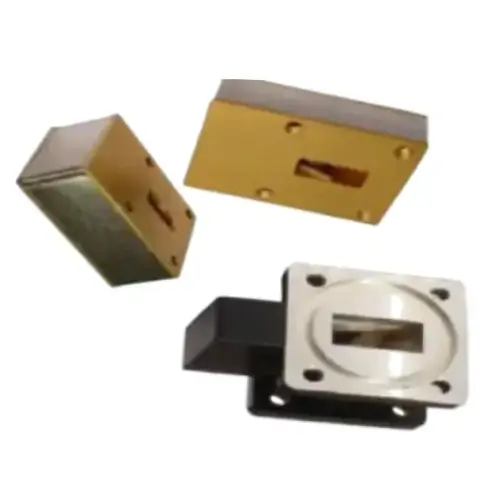
Waveguide Isolators 101: Protecting Your RF Transmission Path Leave a comment
Picture a one-way street built for microwaves. Cars (signal) drive in freely, but if any try to U-turn and come back, they hit a wall. That, in short, is a waveguide isolator.
If you work with radar, satellite uplinks, or microwave links, this small, unglamorous component may be the cheapest insurance you can buy for your most expensive hardware.
The problem: your signal doesn’t always go where you want
No RF system is perfectly matched. Antennas drift out of tune, connectors loosen, ice builds up on a feed horn, a flange gets slightly misaligned. Whenever there’s an impedance mismatch, part of your signal bounces back toward the source.
That reflected power is the quiet killer of RF chains. It can:
- Overheat or permanently damage a power amplifier
- Cause frequency pulling in oscillators
- Distort your signal and degrade efficiency
- Create unstable behavior that’s maddening to troubleshoot
You can’t always prevent reflections. But you can stop them from reaching the parts that matter.
So what is a waveguide isolator?
A waveguide isolator is a two-port, non-reciprocal device. Signals pass through in the forward direction with very little loss, while signals traveling in reverse are absorbed.
Most ordinary passive components are reciprocal, meaning they treat both directions the same. Isolators break that rule on purpose, and they do it with a special material: ferrite.
How it works
Inside the isolator sits a ferrite element, a magnetic ceramic, placed in a strong static magnetic field from a permanent magnet. Ferrite under magnetic bias behaves differently depending on which way a wave travels through it.
- Forward direction: the wave passes through with minimal interaction.
- Reverse direction: the wave interacts strongly with the ferrite and gets soaked up by an absorbing element, turning the reflected energy into a small amount of heat.
Designs vary. Older ones use Faraday rotation, while many modern waveguide isolators use resonance absorption or field displacement. The goal is the same either way.
A close relative is the circulator, which routes power from port to port in sequence. Put a matched load on one port and you’ve effectively built an isolator. Many systems use exactly that setup, especially at higher power, because the load can be cooled separately.
The specs that actually matter
When choosing an isolator, don’t just match the flange and call it a day. Look at:
- Frequency band: isolators are built for specific waveguide sizes (WR-90, WR-75, WR-42, and so on). Operating outside the rated band hurts performance fast.
- Insertion loss: how much forward signal you lose. Good units are typically a fraction of a dB.
- Isolation: how well reverse power is blocked. Around 20 dB or better is common, and more demanding applications want more.
- VSWR: how well the isolator itself is matched at its ports.
- Power handling: both average and peak. This one is easy to underestimate, because the isolator must survive the worst-case reflection, not just normal operation.
- Temperature range: ferrite properties shift with temperature, so performance can drift in harsh environments.
- Flange and size: make sure it fits your mechanical layout.
Where you’ll find them
- Radar systems: protecting high-power transmitters from antenna reflections
- Satellite communications: keeping uplink amplifiers safe and stable
- Microwave point-to-point links: maintaining clean, predictable output
- Test and measurement: shielding signal sources from reflections off the device under test
- Scientific and industrial systems: particle accelerators, plasma and heating equipment, and more
Common mistakes to avoid
Ignoring reflected power in the budget. If your worst-case mismatch sends back half your power, the isolator’s load has to handle it.
- Forgetting about heat. Reflected energy has to go somewhere. At high power, cooling is part of the design, not an afterthought.
- Installing it backwards. Isolators have a direction. Check the markings before you torque those flange bolts.
- Mounting near magnetic materials. Steel brackets or other magnets nearby can disturb the biasing field and affect performance.
- Buying on price alone. A cheap isolator that fails under a reflection event can cost you a transmitter.
Final thoughts
An isolator won’t make your system faster or more powerful, so it rarely gets the spotlight. But when something goes wrong downstream, it’s the component that quietly takes the hit and keeps your amplifier alive.
If your RF chain handles real power, adding a properly rated waveguide isolator is one of the simplest decisions you can make for reliability. Choose the right band, check the power rating honestly, plan for heat, and your transmission path will thank you.