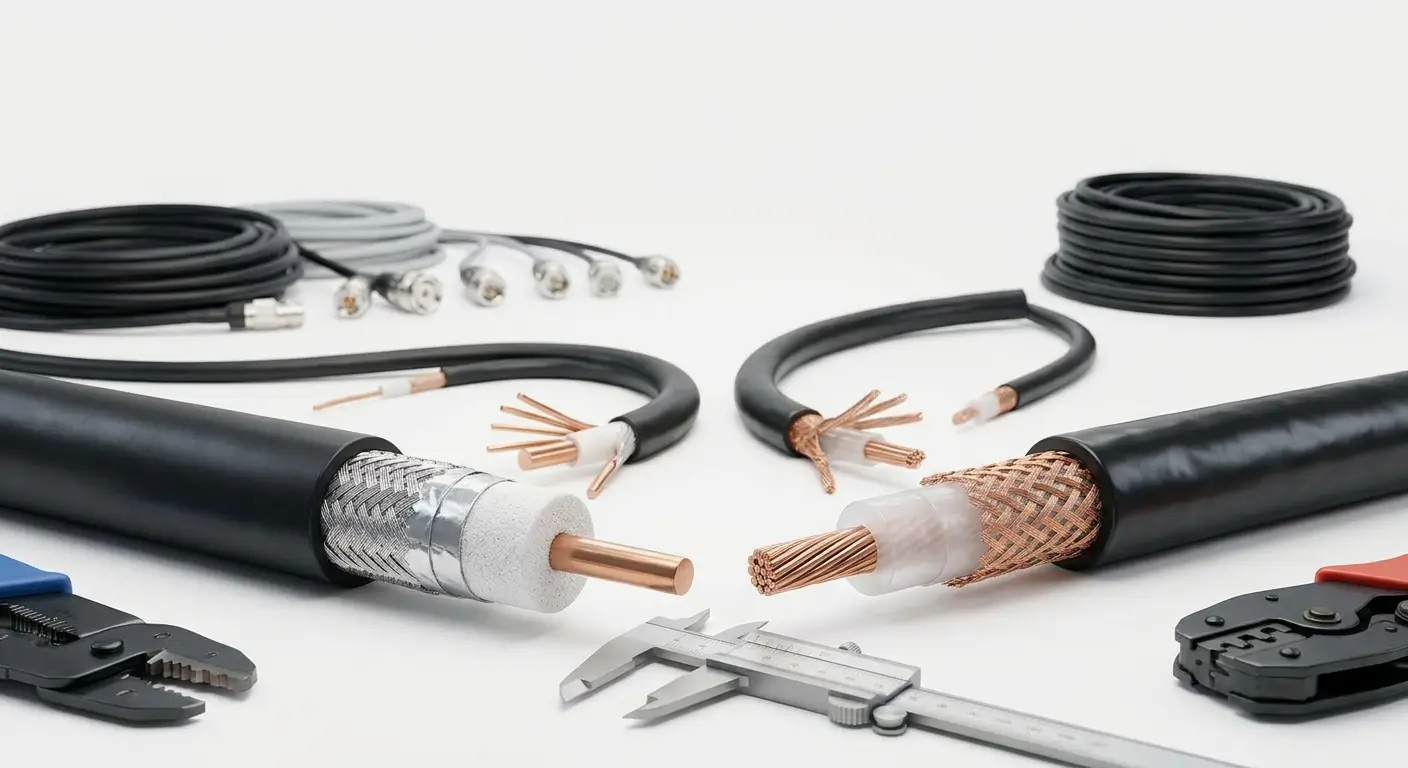
LMR vs RG Cable: Which Is Better for Wireless Infrastructure? Leave a comment
LMR vs RG Cable Which Is Better for Wireless Infrastructure? You can buy the best antenna on the market, mount it perfectly, and still lose half its performance to the cable behind it. Coax is the unglamorous part of a wireless build, and it quietly decides how much of your signal actually survives the trip.
So when someone asks “LMR vs RG Cable?”, the honest answer is: it depends on how far the signal has to travel and how much you can afford to lose.
Introduction
RG cables (RG-58, RG-213, RG-8 and friends) are the old guard. They come from military-era standards, they’re everywhere, and they’re cheap and easy to find.
LMR cables (LMR-195, LMR-240, LMR-400, LMR-600) are a newer, performance-focused family. They use a foam dielectric and better shielding to cut loss, while staying lighter and more flexible than RG cables of a similar size.
Signal Loss
Every meter of coax eats a little signal, and the loss grows with frequency. At 2.4 GHz and 5 GHz, where most WiFi, point-to-point, and IoT gear lives, that loss adds up fast.
Rough attenuation at 2.4 GHz (check each manufacturer’s datasheet for exact figures):
| Cable | Approx. Loss per 10 m |
| RG-58 | 8 to 9 dB |
| RG-213 | 4 to 5 dB |
| LMR-240 | 3.5 dB |
| LMR-400 | 2.2 dB |
Notice how an LMR-400 run keeps roughly half the loss of an RG-213 at a similar thickness. Over a 10 m run, that’s the difference between a healthy link and a struggling one.
Why LMR Usually Wins on Wireless Jobs
- Lower loss: more of your transmit power reaches the antenna, and more of the received signal reaches your radio
- Better shielding: tight braid plus foil keeps interference out and your signal in, which matters on busy rooftops
- Easier to handle: it bends more gracefully and weighs less, so installs go faster
- Outdoor-ready jackets: most LMR types are built for UV and weather exposure
Where RG Still Makes Sense
RG cable isn’t obsolete. It earns its place when:
- Runs are short (patch leads, bench setups, equipment racks)
- The frequency is low (HF, VHF, CB radio, some CCTV and video)
- The budget is tight and the loss won’t hurt
- You’re matching existing infrastructure that already uses RG connectors and cable
A Simple Way to Decide
- Under 3 m, indoors: RG-58 or LMR-195 is fine
- 3 to 15 m, WiFi or 5G: LMR-240 or LMR-400
- Long tower or rooftop feeder runs: LMR-400 or LMR-600
- Low-frequency radio or video: RG-213 or RG-6 does the job
When in doubt, spend the extra on lower loss. A better cable is cheaper than a stronger radio.
Mistakes That Quietly Kill Your Signal
- Choosing cable by thickness alone, without checking the loss spec
- Running thin, cheap cable for a long feeder
- Sharp bends that crush the dielectric and ruin impedance
- Poorly crimped connectors, the number one cause of mystery drops
- Skipping weatherproofing on outdoor connectors
- Mixing 50-ohm and 75-ohm cable in the same chain
No. They’re different cable families with different construction. LMR is designed for lower loss and better shielding.
Usually yes, as long as impedance (50 ohm) and connector types match.
Generally, but construction matters too. LMR-400 and RG-213 are a similar size, yet LMR-400 loses noticeably less.
For anything above a few meters at WiFi or cellular frequencies, almost always.