Yagi Antennas Explained: Best Use Cases for Point-to-Point Links Leave a comment
Think of a normal antenna as a bare bulb: it throws signal in every direction, mostly to places you don’t need it. A Yagi antenna is a flashlight. It collects all that scattered energy and aims it down one path.
That’s why you’ll find Yagis on rooftops, farm sheds, and telecom poles wherever two fixed points need a solid wireless connection.
What Is a Yagi Antenna?
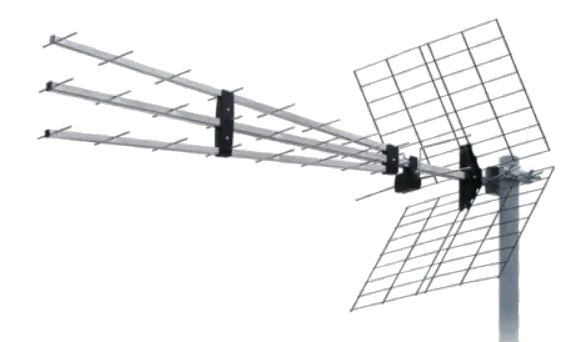
The Yagi-Uda antenna, named after its Japanese inventors, looks like a metal fishbone. Each part has a job:
- Reflector: the longest rod at the back. It bounces signal forward instead of letting it escape.
- Driven element: the only part wired to your radio. It sends and receives the signal.
- Directors: the shorter rods at the front. They focus the signal into a tight beam.
More directors generally mean a narrower beam, more gain, and more reach.Long, cheap cable wastes the gain you paid for. Switch to low-loss HLF LMR series cables for antenna feeder lines.

Why Yagis Suit Point-to-Point Links
A point-to-point (PtP) link connects exactly two locations, so you don’t want an antenna that wastes energy sideways. A Yagi offers:
- High gain for its size: typically around 6 to 15 dBi, depending on the number of elements
- Focused beam: better signal strength and less pickup of unwanted noise
- Good rear rejection: interference from behind the antenna is reduced
- Light weight and low cost: easier to mount and cheaper than most dishes
- Low wind load: the open design handles gusts better than a solid dish
Best Use Cases
| Use Case | Why a Yagi Works |
| Building-to-building WiFi bridge | Links offices, warehouses, or campuses without trenching cable |
| CCTV and remote cameras | Brings video back from a gate, parking lot, or perimeter fence |
| Rural and farm internet | Connects a remote home or shed to a distant access point |
| IoT and sensor networks | Pulls data from water tanks, solar sites, or weather stations |
| Cellular signal boosting | Aimed at a distant tower, it improves 4G/5G reception indoors |
| Radio and telemetry links | Common in amateur radio and industrial monitoring |
| Temporary event links | Quick to set up for construction sites and outdoor events |
When a Yagi Is Not the Best Choice
Be honest about the limits:
- Very long, high-capacity links: a parabolic dish gives higher gain and a tighter beam
- Covering many users in all directions: use a sector or omni antenna instead
- Heavily obstructed paths: no antenna fixes a hill or a dense building in the way
Not sure whether a Yagi is the right fit? Read our guide on directional vs omnidirectional antennas before you buy.
Setup Tips That Make the Difference
- Get line of sight. Trees, walls, and buildings eat signal. Keep the path clear.
- Mind the Fresnel zone. Clear the signal’s invisible “bulge” around the direct path, not just the straight line.
- Match polarization. Both antennas must be mounted the same way, both horizontal or both vertical. A mismatch can cost a large chunk of signal.
- Mount high and stable. Even small movement in wind can drop a narrow-beam link.
- Align slowly. Make small adjustments and watch the signal meter. Don’t chase the first peak you see.
- Use quality cable and connectors, and weatherproof them. Water in a connector is one of the most common causes of dead links.
- Add lightning and surge protection. An outdoor mast attracts strikes, so ground it.
Common Mistakes to Avoid
- Buying on gain numbers alone and ignoring frequency compatibility
- Using long, cheap cable that wastes the gain you paid for
- Skipping a site survey before mounting
- Pointing the antenna at where the other site seems to be instead of verifying it
- Forgetting that more gain means a narrower beam, which makes alignment harder
How to Choose the Right Yagi
- Frequency: match the antenna to your radio (2.4 GHz, 5 GHz, cellular bands, etc.)
- Distance: longer links need more elements and more gain
- Connector type: N-type is common for outdoor setups
- Build quality: look for UV-resistant, corrosion-resistant materials
- Weather rating: it will live outdoors, so check it
Shop Yagi & Directional Antennas → https://ych.solutions/product-category/antennas/.
It depends on frequency, gain, power, and line of sight. Short links of a few hundred meters are easy, and well-planned setups can cover several kilometers.
Not always. Yagis are lighter, cheaper, and easier to install. Dishes win on gain and long-range precision.
You need an antenna at each end, and they should be the same type and polarization for best results.
Heavy rain and ice can reduce signal slightly, especially at higher frequencies. Good materials and sealing prevent most problems.