Directional vs Omnidirectional Antennas: Which One Fits Your Network? Leave a comment
Choosing the right antenna type can make or break your wireless network’s performance. Whether you’re setting up a home Wi-Fi network, a point-to-point link, or an industrial RF system, understanding the directional vs. omnidirectional antennas is essential to getting reliable coverage where you need it.
What Is an Omnidirectional Antenna?
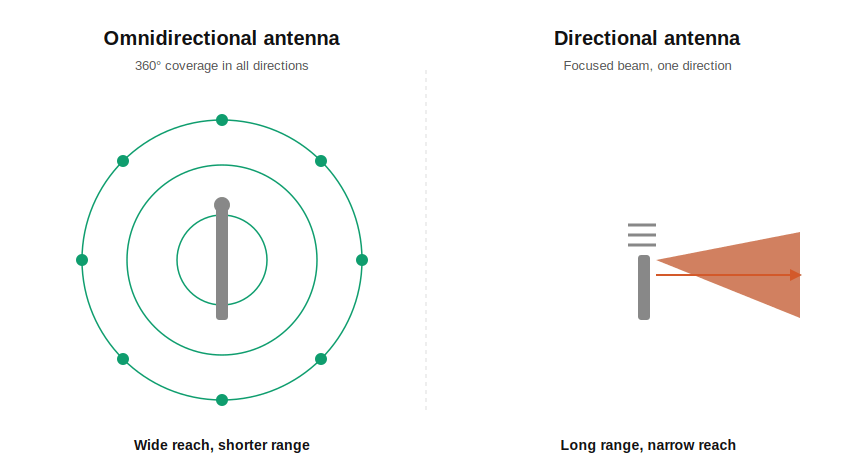
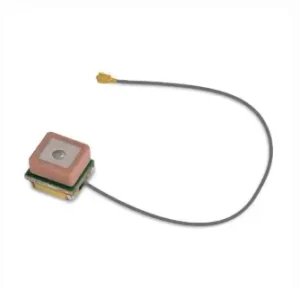
Omnidirectional antennas radiate signal equally in all directions (360°) around a horizontal plane, much like a light bulb illuminating a room. They’re designed to provide broad, even coverage without favoring any single direction.
Key Characteristics:
- 360-degree horizontal coverage
- Lower gain compared to directional antennas
- Ideal for broadcasting to multiple devices spread in different directions
- Typically vertical, pole-like design
Common Applications:
- Home and office Wi-Fi routers
- Public hotspots
- GSM/cellular base stations covering a wide area
- IoT device networks requiring multi-directional connectivity
What Is a Directional Antenna?
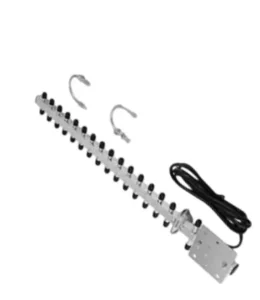
Directional antennas (such as Yagi, parabolic, or panel antennas) focus their signal in a specific direction, concentrating energy into a narrow beam. This results in higher gain and longer range along that focused path, but minimal coverage outside the beam.
Key Characteristics:
- Focused, narrow-beam coverage
- Higher gain and longer transmission range
- Reduced interference from unwanted directions
- Requires precise alignment between transmitter and receiver
Common Applications:
- Point-to-point wireless links (building-to-building connections)
- Long-range rural broadband
- Signal boosting in a specific weak-coverage area
- Backhaul connections for network towers
Key Differences at a Glance
| Feature | Omnidirectional | Directional |
|---|---|---|
| Coverage Pattern | 360° all directions | Focused, narrow beam |
| Gain | Lower | Higher |
| Range | Shorter | Longer (in one direction) |
| Best Use Case | Multi-device, wide coverage | Point-to-point, long-distance |
| Installation | Simple, no alignment needed | Requires precise aiming |
| Interference Resistance | Lower | Higher |
Which One Should You Choose?
Choose Omnidirectional if:
- You need to cover a room, building, or open area with multiple users/devices in different directions
- You’re setting up a standard home or office network
- Ease of installation is a priority
Choose Directional if:
- You need to connect two specific points over a long distance
- You’re extending signal to a distant, fixed location (like a farmhouse or a remote tower)
- You need to minimize interference from surrounding networks
- Maximum range and signal strength in one direction matters more than broad coverage
Final Thoughts
There’s no universal “better” antenna it entirely depends on your network’s purpose. For general-purpose coverage across a wide area, omnidirectional antennas offer simplicity and flexibility. For long-range, high-gain, point-to-point connections, directional antennas deliver the focused performance you need.
Understanding your network’s coverage requirements whether it’s broad accessibility or targeted range will guide you to the right antenna choice in Directional vs Omnidirectional Antennas for optimal performance.